As told by Sackley’s father, Bernard
The Story of Sackley’s Birth
Sackley, our first child of four, was born on March 14, 2012. Together, our family lives in Tema in the Greater Accra Region of Ghana, West Africa. Brenda, my beloved wife, went into labor in the early morning of March 12, 2012. As first-time parents, we called my elder sister, Bertha, and asked for advice on what to do. Bertha asked Brenda to wash down and then go to the hospital. The journey to the nearest hospital, which was North Ridge Clinic in Accra, Ghana, required that we rush through the early Monday morning traffic. It took almost one and a half hours amidst our horn’s constant tooting for other drivers to give way.
At the hospital, the doctor examined Brenda and indicated that she was fine. The doctor gave us the option for a caesarian session (CS) or traditional birth, which we opted for the latter. Unfortunately, that didn’t work out so eventually, Brenda underwent a CS two days later on Wednesday March 14,2012. We were blessed with a beautiful baby girl weighing 2.2kg (4.85 Ibs). There were no major post-birth complications except for Sackley’s neonatal jaundice, which was treated by Sackley spending time under a UV light for some days followed by natural sunlight.
Sackley and Brenda were discharged one week later, and Sackley’s development proceeded just like any other child. She experienced a couple of falls from her bed and pram respectively just like many kids and her pediatrician assured us that Sackley was fine. Sackley achieved almost all of her developmental milestones. She could sit without any trunk support and was “cruising” as doctors termed it (i.e., walking by balancing herself on household furniture such as the sofa, etc.).
The Emergence of Sackley’s Medical Challenges
A few days before her 1st birthday, Sackley fell ill with an infection, which we treated. At Sackley’s birthday party, Brenda’s friend noticed that Sackley’s eyes were oscillating very fast, so we took her to the pediatrician, who then referred Sackley to the eye clinic. After months of constant visits to the eye clinic, the oscillation known as “Nystagmus,” almost completely disappeared. By this time, Sackley was one and half years old, but she had not started walking. We had tried all medical and local techniques used in Ghana for kids who experienced delayed walking but with no success. Even with additional therapy, Sackley was still not walking and had even lost control of her neck. The only explanation her pediatrician offered was that Sackley had a condition called“Delayed Milestone,” but said that Sackley will walk after some time.
Sackley’s Foray into the Educational System in Ghana
As worried parents, Sackley’s pediatrician advised that we send Sackley to school to allow her to socialize with other kids. As part of the school’s admission process, we were to get a medical form completed prior to Sackley’s first day of school. When we dropped Sackley for her first day, , we were told the Proprietor of the school wanted to see us.. That first conversation marked the beginning of our woesas the Proprietor told us that the school oes not have trainedspecialists to assist with Sackley’s condition, so when school ends for the day, we were asked to not not bring Sackley back until she starts walking. At the age of 12, Sackley was still not walking!
Unsure of what the Proprietor was talking about, we asked what condition she was alluding to, and with a surprised look, the Proprietor asked whether we did not know. With that anxious look on our faces, we both responded that we were only told about Sackley’s “Delayed Milestone” condition The Proprietor then gave us medical forms to read and this time to our surprise, the forms spelled it out in black and white: Cerebral Palsy. Our first baby has Cerebral Palsy? It was the biggest shock as a young couple.
Sackley’s Life with Cerebral Palsy
It was extremely difficult leaving the Proprietor’s office that day. Our emotions were a mixture of confusion, anger, sadness, and so on. We began considering what our next line of action should be. Do we sue the hospital (which a loved one suggested)? As we drove to work with tears rolling down our eyes, consoling each other, we decided that our first stop was to the pediatrician’s office to ask why he never told us about the possibility of Cerebral Palsy. We needed to find a cure for our daughter but still in denial, the search for Sackley’s CP (Cerebral Palsy) started.
Our pediatrician recommended that we go to Korle- Bu Teaching Hospital, the biggest hospital in Ghana, to start Physiotherapy (PT).Because of the long distance to Korle-Bu, we moved to the main military hospital in Ghana for a couple of weeks followed by the Children’s Hospital in Accra, and finally to the main general hospital in our city of Tema for the most convenient access to Sackley’s care.
After a lot of travel for Sackley’s appointments, we finally found a PT specialist who agreed to come to our home. While therapy went on at least 3 times a week, we continued to search for a cure despite being told that there was none. We took Sackley to several other hospitals known for bone/orthopedic-related issues and even for amputees in all parts/regions of Ghana. One doctor put her on calcium medication while another just kept telling us to give Sackley fruits. All the while we continued PT but also tried orthodox treatments. Sadly, none of the treatments yielded any positive results. Nevertheless, Sackley continued to endure late-night travels to and from orthodox treatment centers. By age eight, we followed a recommendation to send Sackley to a new orthopedic hospital in Accra. It was then that Sackley was referred to her current pediatric neurologist, a Canadian trained doctor, Dr. Marilyn Marbell of Mission Clinic.
Sackley’s Pursuit of Medical Intervention Abroad
After a year of being treated by Dr. Marbell, she advised that we explore other treatments or management options at other hospitals abroad given the limited resources to support Sackley’s condition in Ghana. Dr. Marbell explained to us that a test, which took a sample of Sackley’s spinal fluid, needed to be done to determine where Sackley fell on the spectrum of CP. We asked if Sackley’s CP could be cured once the test identified Sackley’s CP type. Their answer was “no.” I immediately said there was no need to put Sackley through that painful test.
As we continued our regular visits to Dr. Marbell, she learned that the same test she had previously recommended to test Sackley’s spinal fluid, could be done in the USA or in Canada without the pricking Sackley’s spine. After several engagements, she recommended Kennedy Krieger Institute (KKI) in Baltimore, Maryland because one of her other patients had been sent there for treatment. Brenda took it upon herself to read about KKI and started engaging with their international office. After months of conversations, we got an appointment letter from KKI.
The Blessing of Ronald McDonald House Maryland
With high hopes of getting a cure for Sackley, we applied for a visa in August 2021 at the American Embassy in Accra-Ghana with the support of Dr. Marbell and the International Office team at KKI. Our hope for a cure started to look good as we succeeded in securing visas for Brenda Sackley, and me. Since this was going to be our first time in the USA, and the complications surrounding travel / lodging due to the COVID-19 pandemic, we were very privileged and fortunate to be hosted by our family friends, Kwadwo and Rita in Frederick, Maryland in preparation for an accommodation arrangement in Baltimore.
We finally arrived safely in the USA on September 3, 2021 and were warmly received by our family friends. Hospital appointments started immediately at KKI with a lot of specialty consultations. Finally, we were presented with a treatment plan, which required the family to stay in the USA for many months. This presented a big challenge as we were so concerned about facturing in accommodation costs to our already high medical bills. The thought of going back through that 11-hour journey to our country flashed in our mind but we quickly refused to succumb and refocused on the light at the end of the tunnel: A cure for Sackley. We anxiously started searching for alternative accommodation arrangements. Through the relentless assistance of Amber Carr and Courtney at the International office of KKI, we were admitted to what we will forever call our charity home, the Ronald McDonald House Maryland in Baltimore, MD.
Due to COVID protocols at RMHC, we were required to quarantine for 14 days in an approved Hotel in Baltimore before entering into the House. All too soon the quarantine period was over and on the eve of going to RMH, we received a call from a friendly voice at RMHC and after a few additional checks, we were given the address to the House.
RMHC as a Haven for Sackley Despite Her Medical Struggles
We arrived at the RMHC on October 8,2021 and we were mesmerized, confused again (but positively), sober, delighted and marveled at what we were welcomed to; the reception by the front desk officials, the director on duty and any other staff who met us at the front desk area were all amazing.
The home was indeed so beautiful, likened to a 5-star hotel. We immediately felt the love spreading all over as their mission states. The staff, caring and supportive, always trying to put themselves in our shoes all the while upholding the rules and policies of the House to ensure the safety of all families.
We went through packed and tiring appointment schedules but never had to worry about transportation or finding healthy meals because both were readily available at RMHC. That alone was a huge financial burden lifted from our family.
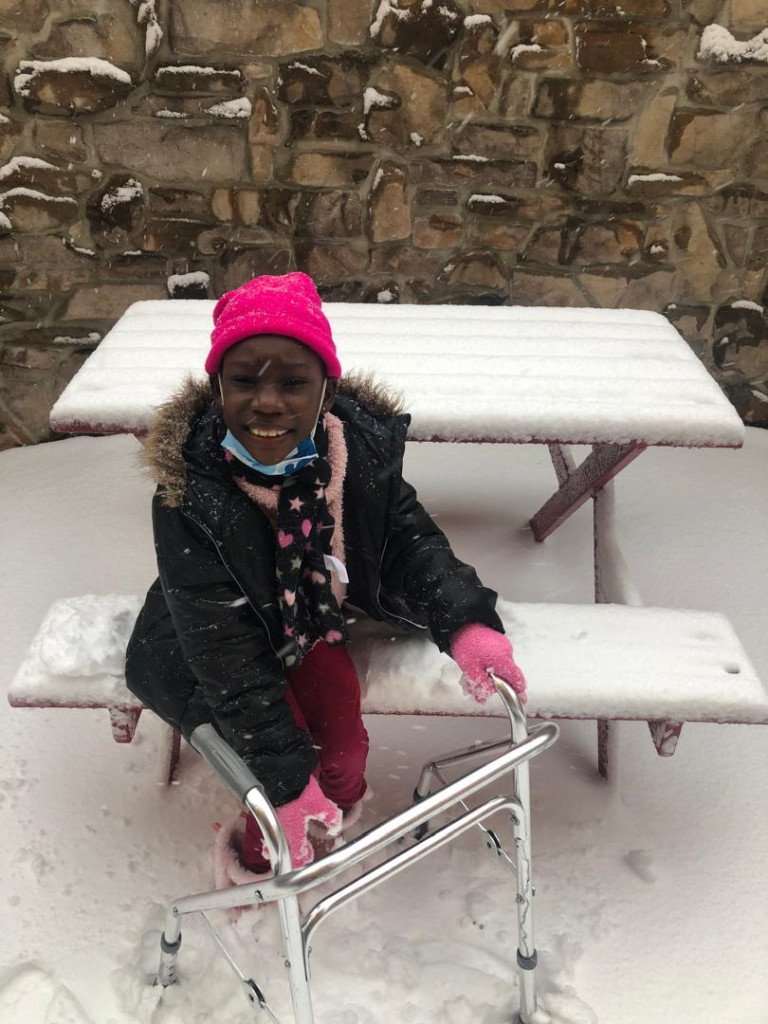
In December of 2021, Sackley saw and experienced snow for the first time and was very excited. She has never stopped talking about that day ever since.
As we continued to consult the orthopedic surgeon, neurologist and other medical specialist at KKI, our journey to find a cure for Sackley developed into a journey of independence for Sackley.
After 8 months, Sackley was medically diagnosed by KKI with a rare condition known as “Hypomyelination with Brainstem and Spinal Cord Involvement and Leg Spasticity,” which is a degenerative condition. But, the strong-willed Sackley is doing her best to defy science and be different.
The Ronald McDonald House has given Sackley the opportunity to build a great social network with wonderful friends – both elderly and age mates – of volunteers, workers, families in the home, and her church family, the Church of Christ in Glenn Burnie.
We are very thankful to the management of the RMHC, especially the leadership of the home, Ms. Sandy, Ms. Susan, and all the special staff of the House for the great support since 2021 to this year for our annual three to four months stay in at Ronald McDonald House Maryland.
With the support of the President & CEO, Ms. Sandy, Sackley can get enrollment in the JTCC Adaptive Tennis program at College Park to build a life skill that she enjoys so much. In addition, Ms. Sandy arranged a private tour of the H& S Bakery for Brenda and me when she found out that we run a small bakery in Ghana to support the family.
We thank the organizers of the Ice Cream van that comes to the House every Thursday. Sackley always looks forward to Thursday and even before her siblings came to America, they were waiting for the day they will visit the RMHC to enjoy the special Ice Cream Sackley talked about.
We thank the ladies of the Ronald McDonald House who helped to keep Sackley’s hair presentable all the time when I, her father, was with her alone at Ronald McDonald House Maryland.
Above all, we thank our creator who has allowed all these experiences and acquaintances to happen in the lives of the Botchway-Anang family. And this is how far Grace has brought us!!!
Sackley Today
On August 4, 2024, we returned to our Baltimore family with our other two children, Sakiorkor (who also have some mild genetic disorder), and Sakikai, both of whom are so excited to be enjoying the ambiance and love at RMHC while assisting Sackley with her appointments in KKI. Sackley is currently using a posterior walker and sometimes a manual wheelchair to be mobile. We are still hopeful that we will be back on the journey to finding cure for Sackley. The search for cure for Sackley is still on and we know the medical team at KKI are doing their very best.